【教育技术 73】沉浸式虚拟现实 | Immersive virtual reality


总第 73 期
构筑教育技术与世界和生活的桥梁
— Computers & Education 195 (2023) 104701 —
Keywords
Immersive virtual reality / 沉浸式虚拟现实
Systematic literature review / 系统文献综述
Learning tasks / 学习任务
Learning design / 学习设计
Cluster analysis / 聚类分析
写在前面
在沉浸式虚拟现实中,感官视觉功能是最容易被采用的设计功能,超过一半的应用程序记录了感官视觉高水平的集成。
The sensory—visual feature was the most readily adopted design feature with more than half of the applications recording high level of integration.

教育研究人员通过探索各种工具和资源的可行性,以提供更好的学习体验。
Educational researchers have explored the possibilities of various tools and resources to provide improved learning experiences.
最新的技术创新之一——沉浸式虚拟现实(IVR)——已经成为教育工作者和研究人员感兴趣的领域。
One of the latest technological innovations—immersive Virtual Reality (IVR)—has become an area of interest amongst educators and researchers.
IVR应用程序设计者可能首先考虑IVR的使用技术,并集成具有代表性的真实感官刺激,以诱导虚拟对象和环境的真实感觉(感官-表征保真度)。
IVR application designers might first consider the technological capabilities of IVR and integrate representationally authentic sensory stimuli to induce the feeling that virtual objects and environments are real (sensory—representational fidelity).
建立优秀的IVR界面设计也是一个重要的技术设计决策,因为它将允许用户在虚拟世界中自然而直观地行动,就像他们在真实环境中进行交互一样(动作交互)。
Establishing a robust IVR interface design is also an important technological design decision because it would allow users to act naturally and intuitively in virtual worlds as if they are interacting in real environments (actional—interactions).
从教学的角度来看,在IVR应用程序中撰写学习内容,是在情感和智力上吸引用户完成任务的关键考虑因素(叙述任务内容)。
From a pedagogical point of view, the way in which the learning content is weaved in IVR applications is a critical consideration to engage users emotionally and intellectually in completing the tasks (narrative—task content).
另一个关键的教学决策是,当学习者在虚拟环境中互动时,如何支持学习(社会-建设性支持)。
Another key pedagogical decision is how to support learning as learners interact in virtual environments (social—constructive support).
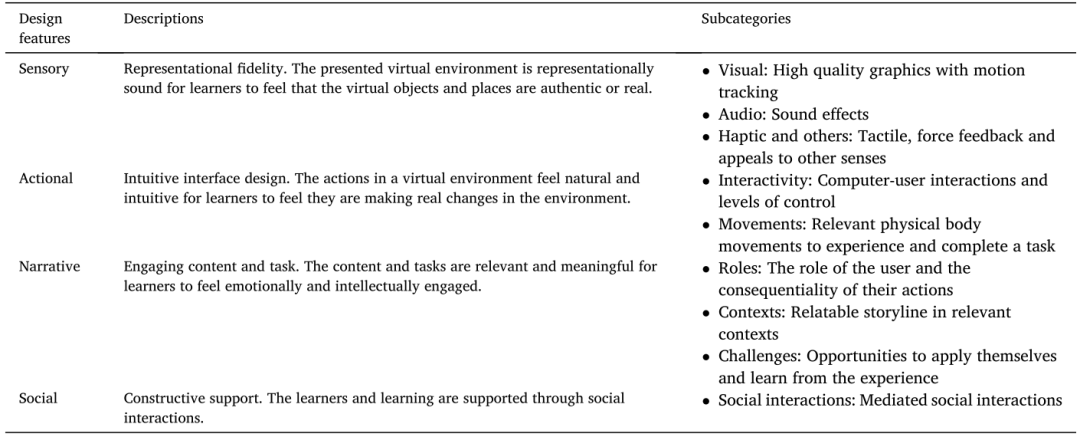
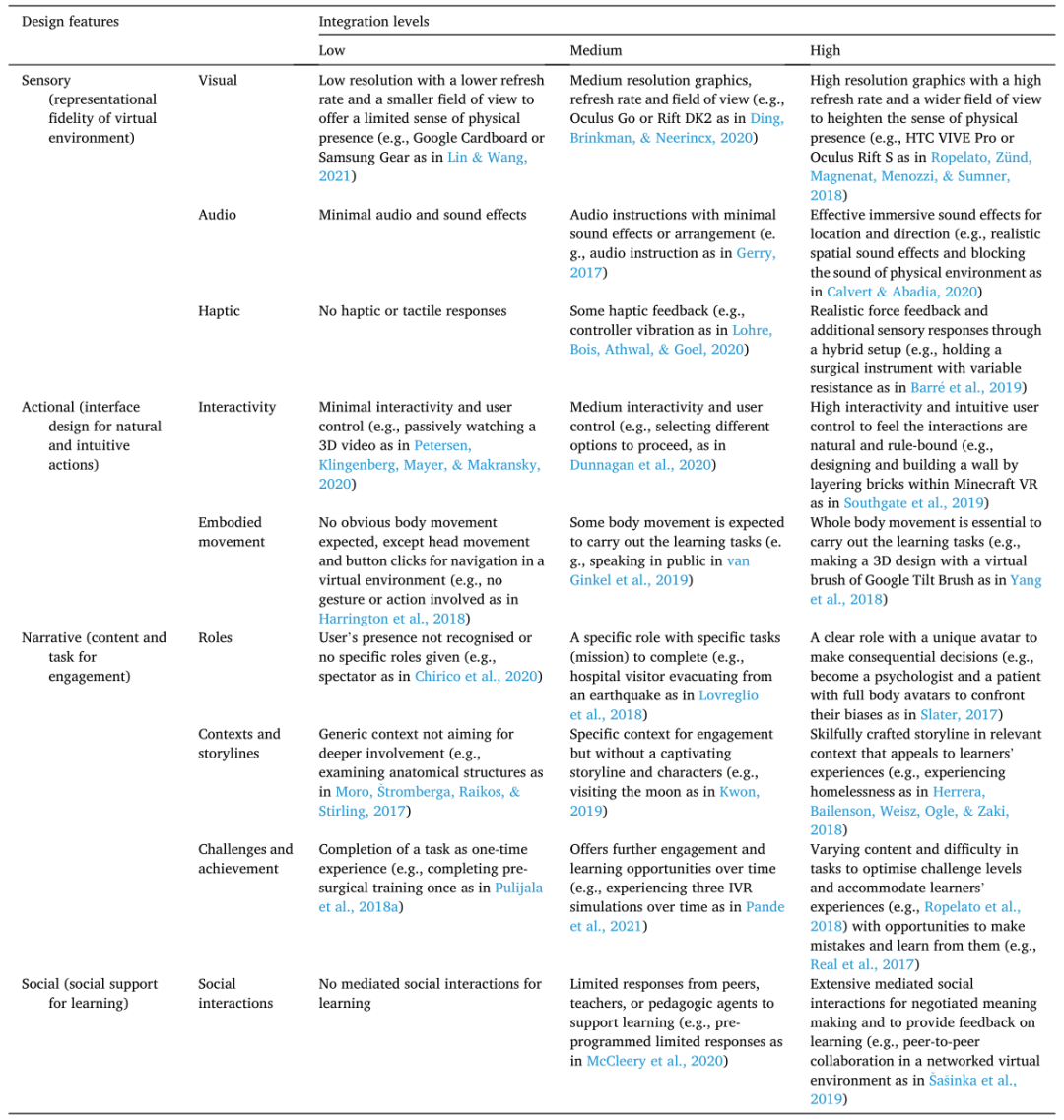
在这四个关键设计特性(两个技术特性和两个教学特性)的前提下,本文的作者确定了IVR的具体设计特性,表1给出了每个设计特性的简明描述。
Within the premise of these four key design features (two technological and two pedagogical), the authors of this review identified specific design features for IVR, a concise description of each design feature is shown in Table 1.
表1 设计特征描述
Table 1 Description of design features
为了研究沉浸式虚拟现实学习是如何在当代教育研究中设计的,本系统的文献综述确定了9个设计特征,并分析了219个关于沉浸式虚拟现实学习活动设计的实证研究。
To investigate how learning in immersive Virtual Reality was designed in contemporary educational studies, this systematic literature review identified nine design features and analysed 219 empirical studies on the designs of learning activities with immersive Virtual Reality.
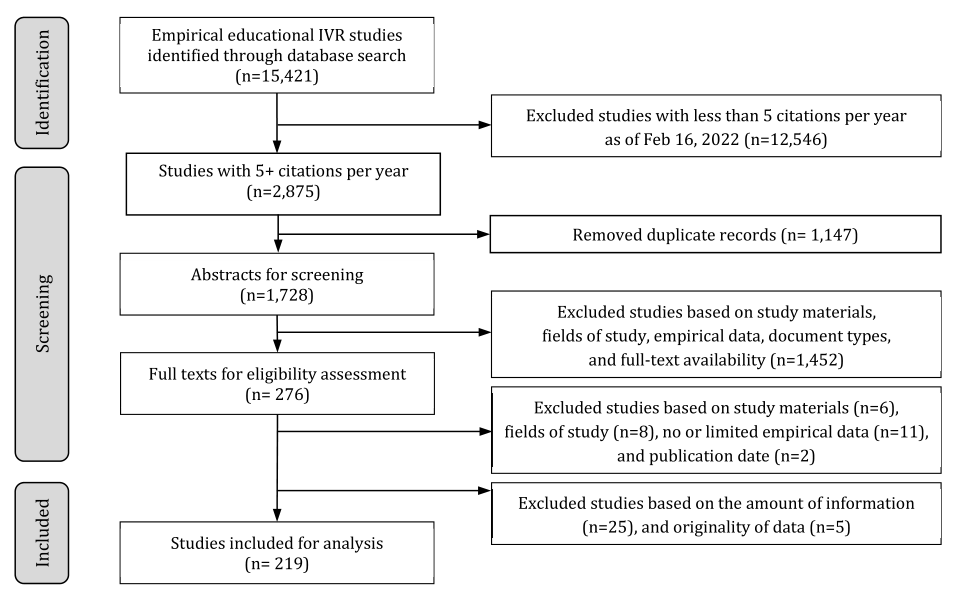
图1 文献筛选流程图
Fig. 1. Flow chart of the literature identification and screening process
表2 IVR教育应用中设计功能的集成分类
Table 2 Categorisation of the integration of design features in educational IVR applications
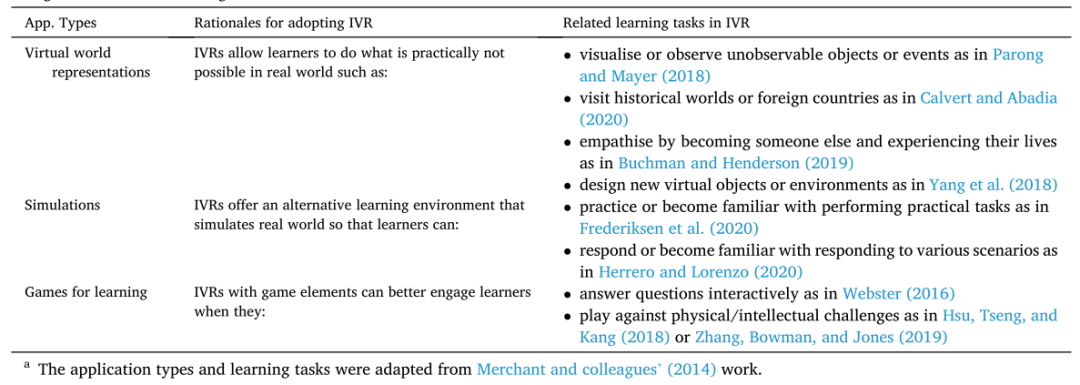
在真实事件或特殊情况的模拟中,学习者通过一系列任务的练习,学习如何应对各种情景或验证假说。
In simulations that imitate real events or situations, learners practice a series of tasks, learn how to respond to various scenarios, or test hypotheses.
学习游戏采用各种游戏元素来吸引用户的注意力,帮助学生实现既定的学习结果。
Games for learning adopt various game elements to absorb users’ attention to help achieve defined learning outcomes.
学习任务可能涉及使用评分系统回答系列问题(游戏化)或涉及身体/智力挑战(游戏玩法)。
The learning tasks may involve answering a series of questions with a scoring system (gamification) or involving physical/intellectual challenges (game play).
表3 学习任务的分类
Table 3 Categorisation of the learning tasks
总的来说,物理层面的技术特征比教学层面的学习参与更容易实现和研究。
Overall, the technological features for physical presence were more readily implemented and investigated than pedagogical features for learning engagement.
IVR教育应用呈现出多样化的设计特征,但一些设计特征会比其他设计特征更容易被采用(见图2)。
Educational IVR applications displayed diverse design features, but some design features were more readily adopted than others (see Fig. 2).
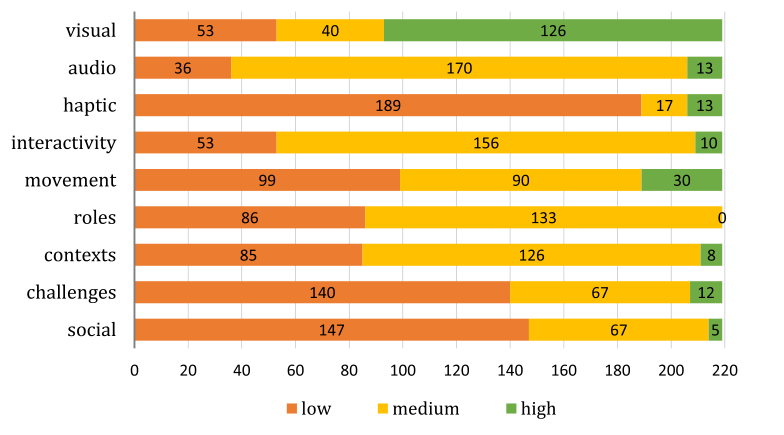
图2 设计特征整合(N = 219)
Fig. 2. Integration of design features (N = 219)
许多应用程序在高端IVR耳机中运行,以提供3D环境的卓越视觉体验(219项研究中有126项)。
Many applications were run in high-end IVR headsets to offer superior visual experience of 3D environments (126 out of 219 studies).
感官视觉功能是最容易被采用的设计功能,超过一半的应用程序记录了感官视觉高水平的集成。
The sensory—visual feature was the most readily adopted design feature with more than half of the applications recording high level of integration.
在感官特征中,触觉反馈被采用的最少,只有30项研究涉及某种形式的触觉反应。
Among the sensory features, haptic feedback was least adopted, having only 30 studies with some form of haptic responses.
研究通过对各个设计特征相互比较,以找到它们之间的关系(见表4)。
Individual design features were compared to one another to find relations between them (see Table 4).
表4 设计特征相关性
Table 4 Correlation between design features.
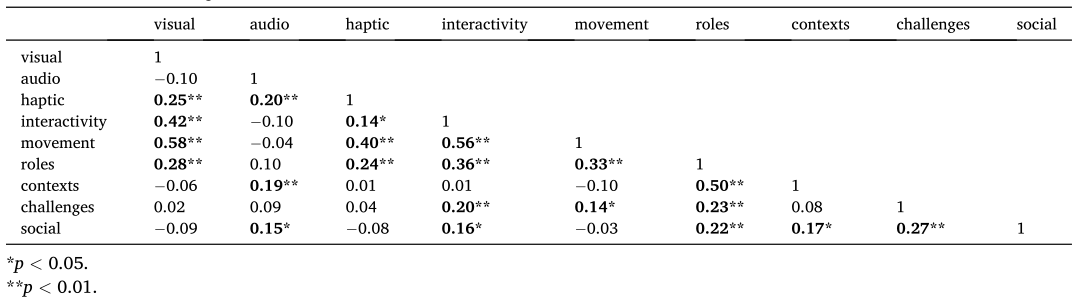
在9个设计特征中,视觉、交互性、具身运动和角色扮演与其他设计特征具有很强的相关性。
Out of nine design features, visual, interactivity, embodied movement, and roles showed strong correlations with other design features.
将设计特征集成与不同类型的应用程序类型进行比较时,与虚拟世界表示相比,模拟显示出更多的设计特征,但只有微小的差异(见表5)。
When the design feature integration was compared against the different types of application types, only minor differences were found with simulations showing slightly more design features compared to virtual world representations (see Table 5).
表5 IVR教育研究中与设计特征整合相关的应用类型(N = 219)
Table 5 Application types in relation to the integration of design features in educational IVR studies (N = 219)

k-means聚类的进一步分析揭示了在学习任务中具有不同互动性和开放性的五种方法,从被动地观看虚拟世界到回应个性化提示。
Further analysis with k-means clustering revealed five approaches with varying levels of interactivity and openness in learning tasks, from watching virtual worlds passively to responding to personalised prompts.
虽然使用了所有9种设计特征来对研究进行分组,但使用了主成分分析法(PCA)并通过三个主要成分来可视化聚类分离(见图3)。
Although all nine design features were used to group the studies, principal component analysis (PCA) was used to visualise the separation of the clusters using three main components (see Fig. 3).
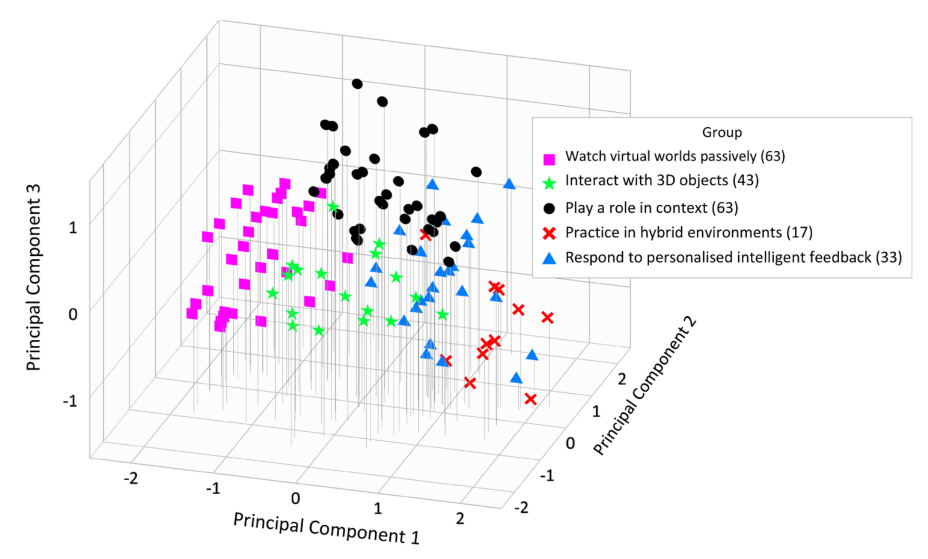
图3 三维散点图显示219个实证研究的五个聚类
Fig. 3. 3D scatter plot to show five clusters of 219 empirical studies
每种方法的设计特征(表6)和学习主题(表7)如下表所述。
The characteristic design features (Table 6) and learning topics (Table 7) of each approach are described below.
表6 IVR教育研究中五种方法设计特点的整合情况
Table 6 Integration of design features of five approaches in educational IVR studies
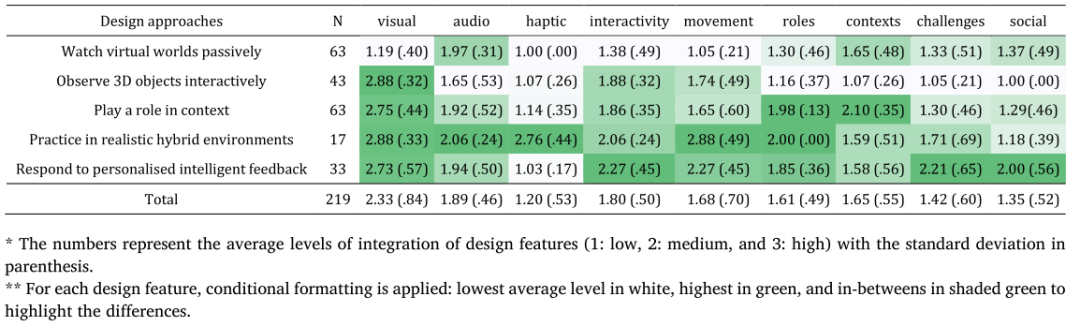
表7 在IVR教育研究中五种方法观察到的常见学习任务
Table 7 Common learning tasks observed in five approaches in educational IVR studies
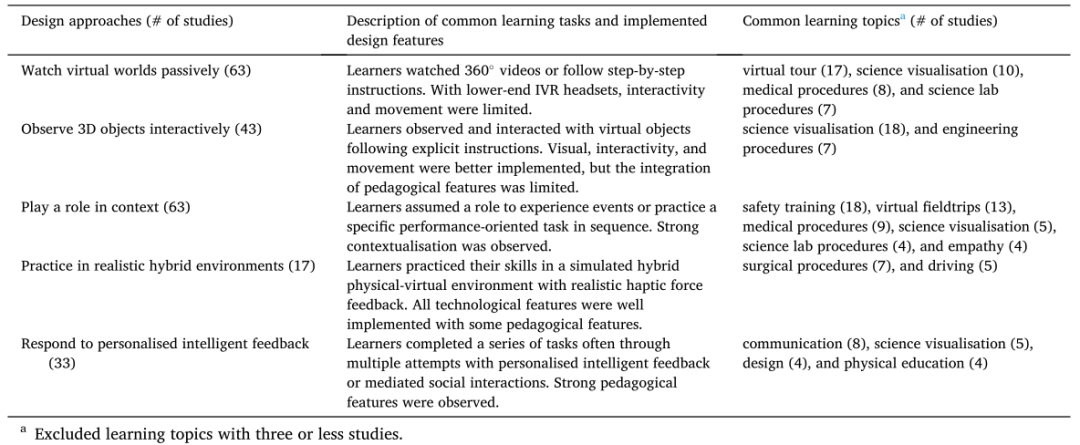
这种设计上的差异似乎源于不同的实践和教育优先级,比如可访问性、互动性和参与性。
Such differences in the design appeared to stem from different practical and educational priorities, such as accessibility, interactivity, and engagement.
这篇综述强调了沉浸式虚拟现实学习任务设计的多样性,并说明了研究人员如何基于实际和正确处理教育问题。
This review highlights the diversity in the learning task designs in immersive Virtual Reality and illustrates how researchers are navigating practical and educational concerns.
我们建议未来的实证研究在设计和评估沉浸式虚拟现实学习时使用不同的方法和优先级。
We recommend future empirical studies recognise the different approaches and priorities when designing and evaluating learning with immersive Virtual Reality.
我们还建议在未来的系统综述中不仅要通过学习主题或学习者人口统计来研究基于沉浸式虚拟现实的学习,还要通过任务设计和学习体验来开展研究。
We also recommend that future systematic reviews investigate immersive Virtual Reality-based learning
not only by learning topics or learner demographics, but also by task designs and learning experiences.
1
END
1
声明:本公众号部分内容和图片来源于期刊文章
版权归原作者所有,如有侵权请联系我们删除
原文请点击“阅读原文”下载查看
作者/ ZHOU JIN
编辑/ ZHOU JIN
校对/ ZHOU JIN
—— 往期推荐 ——
【教育技术 71】当学校的门关闭时,老师们会打开一扇窗户吗? | door closes, teachers open
【教育技术 70】当创客遇到元宇宙 | When makers meet the metaverse
【教育技术 69】人工智能支持的语言学习 | Language learning supported by AI

总第 73 期
构筑教育技术与世界和生活的桥梁
DataVi
ID:Data_Visualizationer
长按-识别-关注
不要忘记!!!
关注/星标/收藏